Cabo de Gata Total Eclipse
Volcanic coast and the driest skies in Europe, with two minutes of totality.
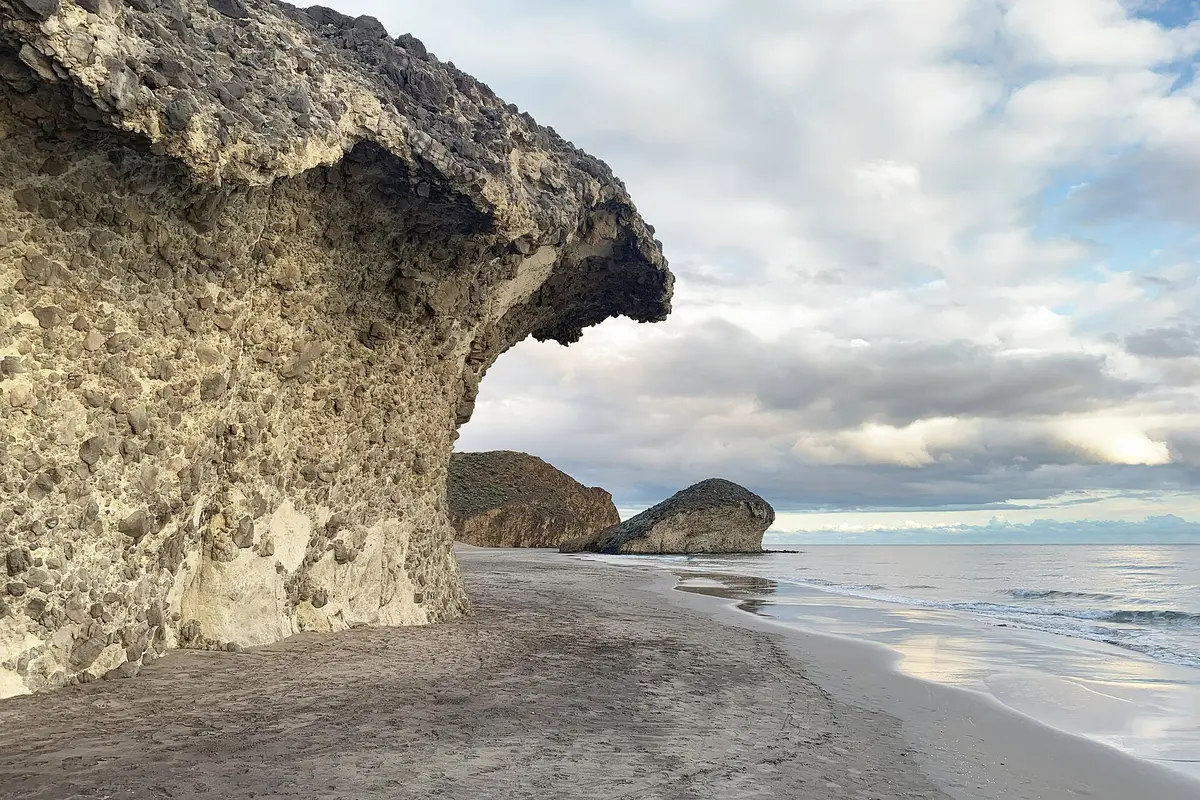
The Cabo de Gata-Níjar Natural Park is a coast of old volcanoes, dark cliffs, salt pans and empty coves, in one of the driest corners of Europe. On Monday 2 August 2027 its southern tip, around the lighthouse and the salt pans, is inside the path of totality. It is the easternmost place on this site where you can see the total eclipse in mainland Spain.
Near the lighthouse the Sun is fully covered for 2 minutes 1 second, from 10:50:50 to 10:52:51 local time (CEST, UTC+2). That ranks 30th of the 43 places in Spain in our dataset. It is also short, and we want to be clear about why. The northern edge of the path is only about 10 km away, and the central line 110 km to the south, far out at sea. The Sun will stand 42° high at an azimuth of 99°, east and a little south.
That edge runs right across this area. Almería city is just outside the path: it sees a 99.99% partial eclipse and no totality. So do the airport, Retamar, the village of Níjar and the northern part of the park around Rodalquilar and Las Negras. Inside the park, totality goes from about two minutes at the lighthouse to nothing at all in less than 20 km. Where you stand matters here more than almost anywhere else on the track.
The eclipse from Cabo de Gata, minute by minute
All times are CEST (UTC+2) on Monday 2 August 2027.
- 09:43 First contact The Moon takes its first bite out of the Sun’s edge. Nothing is visible without eclipse glasses. Put them on now.
- 10:50:50 Totality begins: second contact The last sliver breaks into Baily’s beads, then the diamond ring. When the ring goes out, glasses off.
- 10:51:50 Mid-eclipse Deepest darkness. The corona surrounds a black Sun 42° above the horizon; look for planets and the horizon glow.
- 10:52:51 Totality ends: third contact A second diamond ring flares on the opposite limb. Glasses back on the instant it appears.
- 12:06 Fourth contact The Moon leaves the Sun’s disc and the eclipse is over.
| Eclipse type | Total |
|---|---|
| Duration of totality | 2m 01s |
| Maximum obscuration | 100% |
| Eclipse magnitude | 1.003 |
| Sun’s altitude at maximum | 42° |
| Sun’s azimuth at maximum | 99° |
| Mid-eclipse (UTC) | 08:51:50 |
Cabo de Gata in numbers
Every contact to the second, where the town sits in the path, and how often early August has been clear here.
| Partial eclipse begins | 09:43:47 |
|---|---|
| Totality begins | 10:50:50 |
| Mid-eclipse | 10:51:50 |
| Totality ends | 10:52:51 |
| Duration of totality | 2m 01s |
| Partial eclipse ends | 12:06:22 |
| Distance to the central line | 110 km |
| Distance to the nearest edge (northern limit) | 10 km |
| Rank by duration | 30th of 43 places in Spain in our dataset |
Chance of a clear sky
Period: 26 July to 9 August of every year from 2001 to 2024. The bars show the daily mean cloud cover on 2 August of each year: the taller the bar, the more cloud. On 14 of those 24 days the sky was almost clear.
under 20% 20 to 50% 50% or more
Source: NASA POWER (CERES SYN1deg satellite data), daily mean cloud amount for the 1° grid cell (about 100 km) around Cabo de Gata. It is an average over the whole day and a large area, so it cannot see a sea fog on one beach or the cloud at the hour of the eclipse. It is climatology, not a forecast.
Cabo de Gata on the eclipse map
The gold band is the path of totality. Click anywhere to test a spot of your own; a few kilometres genuinely matters.
Totality across the park
From our own calculation, with local times in CEST:
- Cabo de Gata lighthouse: about 2m 04s, from 10:50:48 to 10:52:52. The longest in the area.
- Near the lighthouse (our reference point): 2m 01s, from 10:50:50 to 10:52:51.
- Mónsul beach: about 1m 57s.
- La Almadraba de Monteleva, by the salt pans: about 1m 49s.
- Los Genoveses beach: about 1m 48s.
- San José: about 1m 33s.
- San Miguel de Cabo de Gata, the village at the northern end of the salt pans: about 1m 20s.
- Almería city, the airport, Retamar, Níjar, Rodalquilar, Las Negras: no totality.
The pattern is simple: the further south you are, the longer totality lasts. The southern tip around the lighthouse is the place to be.
Near the edge: what it means
Near the edge of the path the Moon only just covers the Sun, and it slides across it at a grazing angle. Totality is short, but the Baily’s beads, the points of sunlight shining through valleys on the Moon’s rim, and the thin pink glow of the chromosphere last longer than on the central line. The corona still appears. Some observers choose the edge on purpose for this.
Two cautions. First, predictions near the edge are less exact: the mountains and valleys on the Moon’s limb matter more, and real times can differ by a few seconds from any calculation, ours included. Second, do not stand right on the edge and hope. Stay well inside the path, at the southern tip. With two minutes, look first and photograph later, and read our eye safety guide before the day.
Where to watch
The lighthouse and the Arrecife de las Sirenas
The lighthouse stands on the cliffs at the southern tip of the cape, above the volcanic reef known as the Arrecife de las Sirenas. There is a viewpoint with open views over the sea. It is the best spot for totality in the park, and everyone who knows it will want to be there. The road is narrow and parking at the end is limited. Arrive very early, or be ready to watch from further back along the road, where totality is only a few seconds shorter.
The salt pans and La Almadraba de Monteleva
Along the road from San Miguel to the lighthouse, the beach runs beside the salt pans of Cabo de Gata, known for their flamingos. This long, open shore gives you plenty of space, and totality grows as you drive south along it: about 1m 20s in San Miguel, about 1m 49s at La Almadraba, about 2m at the lighthouse end. There is no shade.
Mónsul and Los Genoveses
The famous wild beaches west of San José, with volcanic rock and dunes, get about 1m 57s and 1m 48s. They are reached on an unpaved road from San José, and in summer car access to this area has been limited in past years. We do not know what rules will apply on eclipse day. Check with the park or the town hall of Níjar before you plan on them.
San José
The main village of the park, with a small harbour, a beach and most of the services. Totality is about 1m 33s. If you are staying here, you can watch from the beach, or head south west towards Mónsul for more time if access allows.
Staying in Almería city?
You must drive to see totality. The nearest easy option is the road along the salt pans towards the lighthouse, roughly 40 minutes away in normal traffic. On eclipse morning many others will do the same. Leave by 08:00 at the latest. Heading west to Roquetas de Mar also works: it gets 1m 34s.
The eclipse morning
- 09:43:47: the partial eclipse begins.
- 10:50:50 to 10:52:51: totality, 2m 01s, near the lighthouse. Glasses off only in this window.
- 12:06:22: the partial eclipse ends.
The roads into the southern tip of the park are few, narrow and single carriageway. Almería has about 200,000 people, all outside the path, and the obvious place for them to go is here. Expect the road past the salt pans to be the busiest in the park that morning. Be parked by about 08:30, bring water, food and shade for the whole morning, and do not try to leave at 10:53. Stay for lunch and leave in the afternoon.
This is a protected natural park. Keep to roads and parking areas, take your rubbish home, and follow any rules the park sets for the day. Check the DGT live traffic map before you set out, and see the eclipse day planner.
Getting there
- By air. Almería airport lies east of the city, on the way to Cabo de Gata. The lighthouse is roughly half an hour away by road. Málaga and Granada airports are much further.
- By car. The A-7 leads to Almería along the coast from Málaga and from Murcia, and the A-92 from Granada. From the city, local roads run past the airport to the park. Spain drives on the right. A car is close to essential here.
- By train. Almería has a railway station with long-distance services. Check routes well ahead. The park itself has no railway.
- By bus. Buses run from Almería to San Miguel de Cabo de Gata and San José. Services are limited, so check timetables well ahead.
- By sea. Ferries link Almería with Melilla and with Morocco.
Where to stay
San Miguel de Cabo de Gata and the salt pans
A small village with apartments and holiday homes, and the road to the lighthouse on its doorstep. Supply is small. Search Cabo de Gata for 1 to 3 August 2027.
San José
The main base inside the park, with small hotels and apartments. Totality there is about 1m 33s, with more a short drive south west. Search San José for 1 to 3 August 2027.
Almería city
The most rooms by far, but outside the path. Only choose it if you are ready to drive early on the morning. Search Almería city for 1 to 3 August 2027.
Roquetas de Mar
A large resort west of Almería, inside the path with 1m 34s. You can watch from its own beach and skip the traffic to the park. Search Roquetas de Mar for 1 to 3 August 2027.
These are plain search links, not affiliate links. We do not quote prices, which change daily. Where you can, book a rate with free cancellation.
Weather: dry does not mean cloudless
Cabo de Gata is famous for how little rain it gets. Rain, though, is not the issue on an August morning. What matters is cloud and haze at 10:50. In our satellite data for 26 July to 9 August, 2001 to 2024, 65% of days in this cell were almost clear, with under 20% cloud, and 8% were half cloudy or worse. The typical day had 13% cloud. On 2 August itself, 14 of the 24 years were almost clear.
That is a good record, in the same range as the Strait of Gibraltar, but it is not the best on the Spanish part of the track: the Costa Tropical cell around Almuñécar scores 72%. The figures are daily means over cells about 100 km across, so treat them as a regional comparison, not a forecast. Summer mornings on this coast can also bring haze, which does not stop a total eclipse but can soften the view. Check the AEMET forecast in the days before, and see our weather page.
Beyond the eclipse
- The coves of the park. Mónsul, Los Genoveses and the smaller coves along the coast, many reached only on foot.
- The salt pans, with flamingos and other water birds.
- Rodalquilar, a former gold mining village in a volcanic crater, now part of the park.
- The Alcazaba of Almería, the great Moorish fortress above the city.
- The Tabernas desert, inland, where many westerns were filmed.
Compare with Almuñécar, Nerja and the longer totality around Tarifa, or see every Spanish town side by side in our southern Spain eclipse guide.
Cabo de Gata eclipse questions
How long is totality at Cabo de Gata?
2 minutes 1 second near the lighthouse, from 10:50:50 to 10:52:51 CEST (UTC+2) on Monday 2 August 2027, and about 2m 04s at the lighthouse itself. The partial eclipse runs from 09:43:47 to 12:06:22.
Can I see the total eclipse from Almería city?
No. Almería city is just outside the path and sees a 99.99% partial eclipse, with no totality. Drive south east to the Cabo de Gata lighthouse, or west to Roquetas de Mar.
Is San José inside the path of totality?
Yes, with about 1m 33s. The northern part of the park, around Rodalquilar and Las Negras, is outside the path. The southern tip around the lighthouse has the most time.
What are the chances of a clear sky at Cabo de Gata?
In satellite data for 26 July to 9 August, 2001 to 2024, 65% of days were almost clear and 8% were half cloudy or worse. On 2 August, 14 of 24 years were almost clear.
Sources
- Our sources and methodology: how the times, durations and cloud figures on this page are made.
- NASA eclipse map for 2 August 2027 (Fred Espenak, NASA/GSFC).
- Xavier Jubier’s interactive map, with lunar limb corrections.
- NASA POWER, the source of the cloud climatology.
- Instituto Geográfico Nacional (IGN), the official Spanish eclipse page, with times for every municipality.
- AEMET municipal forecast, the official Spanish weather service.
- DGT live traffic, for road conditions on the morning.
Compare with nearby options
Almuñécar
The Costa Tropical resort town, with almost two minutes of totality.
Full guide → Total: 1m 42s Southern SpainNerja
Cliffs, coves and the Balcony of Europe, close to the northern edge of the path.
Full guide → Total: 4m 38s Southern SpainTarifa
Where the umbra first touches Europe, on the southern tip of Spain.
Full guide →